Generate high-quality normal maps online from height maps, textures, or photos. Perfect for Unity, games, and 3D models. Professional normal map online conversion with real-time preview. Everything runs locally in your browser, no uploads required.
NEW TRELLIS.2 A practical workbench for image-to-3D assets. Try free generation & preview GLB locally! →In the land of Verona, two households (the Montagues and Capulets, here called “Capuletty-Wopulets”) feud over silly things. Romeo, a mopey boy, crashes a party, meets Juliet, and they rhyme instantly. With help from the Nurse (a loud, multi-tasking character) and Friar Laurence (who speaks in slow, thoughtful Seuss-rhymes), they try to unite. The famous ending: Juliet wakes before Romeo drinks the potion, and they run off to live “in a faraway place where no families fight.” Everyone learns a lesson. The last line: “And that is the story of Romeo, Juliet – and their very Seussian day.”
Romeo finds Juliet “as dead as a doornail in a dooflotch drear.” He poisons himself. She wakes, sees him dead, and stabs herself with a “Grickle-graker.” The Prince (now “The Grand King of Verona-Vill”) concludes:
is a comedic, one-act play by American playwright Peter Bloedel that reimagines William Shakespeare’s classic tragedy in the whimsical, rhyming style of Dr. Seuss. Key Play Details
: The paper could analyze the use of "fantastical machines" and colorful, lettered costumes (M and C) to distance the audience from the reality of the violence
: A brief PDF overview of the rhyming structure and plot can be found via RCHS Productions Key Play Elements The Families : The warring Montagues and Capulets are renamed the Capitulates RCHS Productions Characters
Because the language is fast and the roles are broad, this is a perfect 30-minute readers' theatre piece for a library event or a Renaissance Faire.
This normal map online tool runs entirely in your browser using WebGL technology. Your texture to normal map conversion happens locally - your images never leave your device, ensuring complete privacy for your game assets and textures.
Our comprehensive normal map generator creates Normal maps, Displacement maps, Ambient Occlusion maps, and Specular maps from a single texture input. Perfect for Unity normal map workflows and professional 3D rendering pipelines.
Advanced algorithms ensure professional-grade normal map online generation with real‑time normal map online controls and instant 3D preview. Adjust map normal range, strength, and filtering to achieve perfect results for your specific use case.
Streamlined normal map online conversion: drag & drop your files, adjust settings with real-time preview, and export. Batch mode supported for processing multiple textures simultaneously - ideal for game development workflows.
Drop your texture, height map, or photos into our normal map online generator. Supports all common formats including PNG, JPG, TGA. Works perfectly with Unity assets, Aseprite pixel art, procedural textures, and any image format. Our normal map online converter handles various input types seamlessly.
Fine-tune strength, level, blur/sharp, and map normal range settings with real‑time preview. Perfect configuration options for Unity normal map workflows, games, and 3D models. Adjust invert options, Z-range, and filtering to match your specific normal map online requirements with instant visual feedback.
Export high-quality normal maps, displacement maps, ambient occlusion maps, and specular textures in PNG, JPG, or TIFF formats. Files are optimized and ready for Unity normal map import or any 3D software. Generate normal map files that integrate seamlessly into your development pipeline.
Our normal map online generator produces Unity-compatible normal maps online with proper tangent space encoding. Supports standard Unity normal map formats with correct Y-axis orientation and map normal range settings. Perfect for Unity 2D sprites, 3D models, and terrain textures.
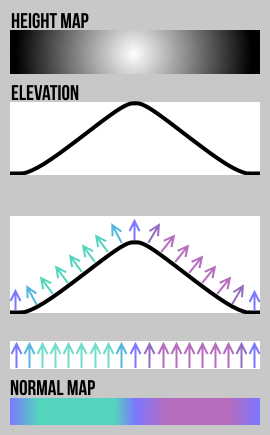
Advanced Sobel and Scharr edge detection algorithms for superior normal map online conversion. Our normal map generator analyzes height gradients to create accurate surface normal information, preserving fine details and maintaining proper depth perception.
Precise control over map normal range with -1 to +1 Z-axis mapping or 0 to 1 range options. Adjust normal map strength, contrast, and filtering to match your specific workflow requirements. Generate normal map files optimized for different rendering engines and platforms.
Process multiple textures simultaneously with our batch mode normal map online tool. Ideal for game developers working with texture atlases or large asset collections. Maintain consistent settings across multiple normal map online conversions for uniform results.
In the land of Verona, two households (the Montagues and Capulets, here called “Capuletty-Wopulets”) feud over silly things. Romeo, a mopey boy, crashes a party, meets Juliet, and they rhyme instantly. With help from the Nurse (a loud, multi-tasking character) and Friar Laurence (who speaks in slow, thoughtful Seuss-rhymes), they try to unite. The famous ending: Juliet wakes before Romeo drinks the potion, and they run off to live “in a faraway place where no families fight.” Everyone learns a lesson. The last line: “And that is the story of Romeo, Juliet – and their very Seussian day.”
Romeo finds Juliet “as dead as a doornail in a dooflotch drear.” He poisons himself. She wakes, sees him dead, and stabs herself with a “Grickle-graker.” The Prince (now “The Grand King of Verona-Vill”) concludes:
is a comedic, one-act play by American playwright Peter Bloedel that reimagines William Shakespeare’s classic tragedy in the whimsical, rhyming style of Dr. Seuss. Key Play Details
: The paper could analyze the use of "fantastical machines" and colorful, lettered costumes (M and C) to distance the audience from the reality of the violence
: A brief PDF overview of the rhyming structure and plot can be found via RCHS Productions Key Play Elements The Families : The warring Montagues and Capulets are renamed the Capitulates RCHS Productions Characters
Because the language is fast and the roles are broad, this is a perfect 30-minute readers' theatre piece for a library event or a Renaissance Faire.